
When Do I Need a Covid Test?
COVID-19 can still cause anything from mild cold-like symptoms to significant respiratory illness. Because symptoms can overlap with influenza and other respiratory infections, testing may help patients understand what may be causing their illness and decide what steps to take next. At Triad Primary Care, our team provides COVID-19 testing at its Greensboro, North Carolina, primary care location. Patients can also receive primary care and laboratory services when appropriate, allowing testing to be considered alongside symptoms, medical history, and individual risk factors rather than viewed as an isolated result. For more information, contact us or book an appointment online. We are conveniently located at 1309 Lees Chapel Rd., Greensboro, NC 27455.
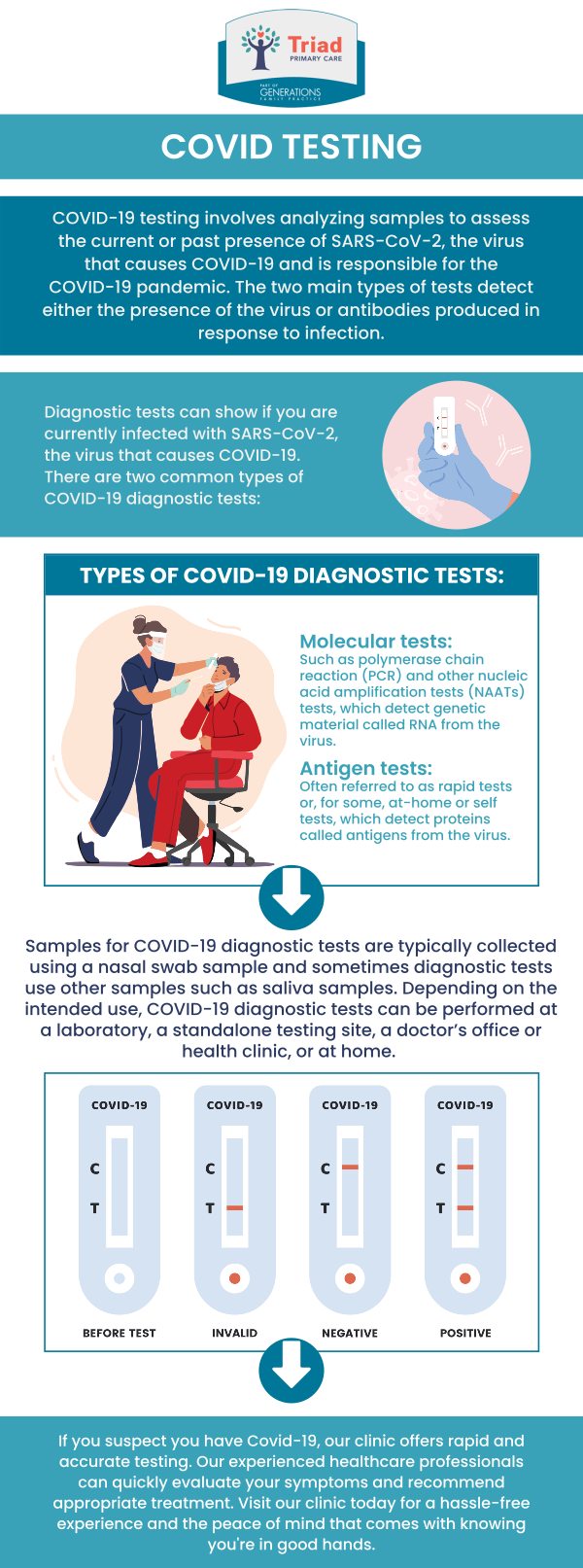
Table of Contents:
Why should I visit a COVID test clinic instead of relying only on an at-home test?
What is the difference between a COVID-19 PCR test and an antigen test?
Can I have COVID-19 even if my first rapid test is negative?
When should I consider clinic-based testing after a negative home COVID test?
Can a COVID test tell whether my symptoms are actually caused by influenza or another respiratory virus?
What symptoms may make COVID-19 testing appropriate?
Should I get tested if I was exposed to COVID-19 but feel completely well?
How soon after COVID exposure can a test become positive?
How reliable is a negative COVID-19 test in 2026?
What does a positive COVID-19 test mean?
Why is early COVID testing particularly important for people at higher risk?
Do I need a positive test before asking about COVID-19 treatment?
Can a primary care visit help if I test positive for COVID-19?
How long should I stay home if I have COVID-like symptoms?
What precautions should I take after I start feeling better?
Can I still spread COVID-19 after my fever is gone?
Should I test before visiting an older or medically vulnerable family member?
Can vaccination affect my COVID test result?
When should COVID symptoms be treated as a medical emergency?
What should I bring to a COVID testing appointment at Triad Primary Care?
Medical references
At-home COVID-19 tests can be useful, especially when symptoms first appear or testing needs to be done quickly. However, a negative home antigen test does not always rule out COVID-19. Antigen tests may miss an infection when the amount of virus in the body is still low.
Visiting a primary care clinic may be helpful when symptoms continue despite a negative home test, when a patient has medical conditions that increase the chance of severe illness, or when there is uncertainty about what the symptoms mean. Triad Primary Care offers COVID-19 testing in Greensboro. Clinical evaluation may also help determine whether symptoms could be related to another respiratory illness or require additional medical attention.
Both tests look for evidence of an active SARS-CoV-2 infection, but they work differently. A PCR test is a type of molecular test. It looks for genetic material from the virus and can detect smaller amounts of virus than many antigen tests. This generally makes molecular testing more sensitive.
An antigen test detects specific viral proteins. Antigen testing can be useful because it is simpler and often produces results more quickly, but it is more likely to miss an infection early in the illness. For that reason, a negative antigen result sometimes needs to be repeated. The best test can depend on the patient’s symptoms, timing, recent exposure, and medical risk.
Yes. A single negative antigen test cannot completely rule out COVID-19. Early in an infection, the amount of virus in the nose may be too low for an antigen test to detect. The FDA therefore recommends repeat testing after a negative antigen result. For people who have symptoms, current FDA guidance generally calls for at least two antigen tests performed 48 hours apart. People without symptoms may need three tests performed 48 hours apart over approximately five days. Patients whose symptoms persist, worsen, or do not fit their test results may benefit from a medical evaluation rather than continuing to rely only on home testing.
Clinic-based testing may be worth considering when symptoms continue despite one or more negative home antigen tests, particularly when there has been a known exposure or when the person is at increased risk for severe COVID-19. A clinical visit may also be useful if respiratory symptoms are getting worse, if symptoms could be caused by another illness, or if a patient needs guidance about treatment eligibility.
Someone who develops breathing difficulty, persistent chest pain or pressure, new confusion, inability to stay awake, or other severe symptoms should not wait for routine clinic testing. Emergency medical care may be necessary.
A standard COVID-19 test only looks for SARS-CoV-2, the virus that causes COVID-19. It cannot automatically determine whether a patient has influenza, RSV, strep throat, or another condition. This matters because COVID-19, influenza, and other respiratory infections can produce similar symptoms. Fever, cough, sore throat, congestion, fatigue, headache, and muscle aches may occur with several illnesses.
Some molecular tests are designed to detect more than one respiratory virus, but patients should not assume every COVID test includes influenza or RSV testing. A healthcare professional can consider the overall symptom pattern and determine whether additional evaluation may be appropriate.
COVID-19 can cause a wide range of symptoms. Common possibilities include cough, sore throat, congestion, runny nose, fever or chills, fatigue, headache, muscle or body aches, shortness of breath, nausea, vomiting, diarrhea, and changes in taste or smell.
Symptoms can vary from one infection to another, and newer variants do not necessarily produce the same symptom pattern in every person. Because symptoms overlap with influenza and other respiratory illnesses, symptoms alone cannot reliably identify COVID-19. Testing can provide additional information, particularly when symptoms are new or a patient has recently been around someone with COVID-19.
Testing can still be useful after an exposure because people can be infected without having noticeable symptoms. Timing matters. Testing immediately after exposure may be too early because the amount of virus may not yet be high enough to detect. FDA guidance advises people without symptoms who were exposed to COVID-19 to wait at least five full days after exposure before taking an initial test.
If an antigen test is negative, repeat testing may be needed because one negative result does not completely rule out infection. Patients who develop symptoms before the planned testing date should test at that point rather than waiting.
There is no exact time that applies to everyone. After exposure, the virus needs time to reproduce before a diagnostic test can reliably detect it. Testing too soon can therefore produce a negative result even when an infection is developing. For people without symptoms after a known exposure, current FDA guidance recommends waiting at least five full days before initial testing.
If symptoms develop, testing can be performed sooner. A negative antigen test may still need to be repeated 48 hours later. The timing of exposure, symptom onset, and previous test results are all useful pieces of information to share during a clinic visit.
A negative result reduces the likelihood that COVID-19 is causing the patient’s symptoms, but its meaning depends heavily on the type of test and when it was taken. Molecular tests such as PCR are generally more sensitive than antigen tests. Antigen tests are more likely to produce false-negative results, particularly early in infection or in people without symptoms.
For this reason, the FDA continues to recommend serial testing after a negative antigen result. Patients should consider the result together with symptoms, exposure history, and medical risk. When symptoms continue or the clinical picture does not match a negative result, additional testing or medical evaluation may be appropriate.
A positive COVID-19 diagnostic test generally indicates that SARS-CoV-2 was detected and that the person is likely infected. The next steps depend partly on symptoms and medical risk. Someone with mild illness may primarily need supportive care and precautions to reduce the chance of spreading the virus.
Patients at increased risk for severe COVID-19 should contact a healthcare professional promptly because antiviral treatment may need to begin within the first several days of symptoms. A positive test does not indicate how severe the illness will become. Age, underlying health conditions, immune status, vaccination history, and other factors influence individual risk.
For people at higher risk of severe illness, testing is not only about confirming the cause of symptoms. It may also affect whether treatment can be started within the recommended window. Current CDC guidance states that outpatient COVID-19 treatments for eligible patients generally need to begin within five to seven days after symptoms start, depending on the medication.
Risk increases with age and can also be affected by certain chronic illnesses or a weakened immune system. Patients who may be at higher risk should therefore contact a healthcare professional promptly after developing respiratory symptoms rather than waiting several days to see whether the illness resolves on its own.
Not necessarily. Current CDC clinical guidance emphasizes that eligible high-risk patients should seek medical advice early because treatment works best when started promptly. A positive test is not always required before a healthcare professional can consider treatment, and waiting unnecessarily for test results could cause a patient to miss the treatment window.
Treatment decisions require an individual medical assessment. Certain medications can interact with prescription drugs or may not be appropriate for patients with particular medical conditions. Patients should not start, stop, or change prescription medication based only on general online information.
Yes. A positive result may raise questions that a test alone cannot answer.
A primary care evaluation can consider the patient’s symptoms, age, medical history, current medications, risk factors, and whether symptoms are improving or becoming more concerning. That information may help determine whether monitoring and supportive care are reasonable or whether additional medical attention should be considered.
Triad Primary Care provides primary care along with COVID-19 and laboratory testing at its Greensboro location. Patients at increased risk of severe COVID-19 should seek guidance early because some antiviral treatments must be started within a limited number of days after symptoms begin.
Current CDC respiratory virus guidance no longer uses one fixed isolation period for everyone with a respiratory illness. People with respiratory symptoms should generally stay home and away from others until their symptoms are improving overall and they have been fever-free for at least 24 hours without using fever-reducing medicine.
After returning to normal activities, the CDC advises taking additional precautions for the next five days because transmission may still be possible. Precautions can include improving ventilation, practicing good hygiene, wearing a well-fitting mask around others, creating physical distance, or testing when appropriate. Individual circumstances can differ, especially for people who are immunocompromised.
Feeling better does not necessarily mean that the chance of spreading a respiratory virus has disappeared immediately. Once symptoms are improving overall and there has been no fever for at least 24 hours without fever-reducing medication, normal activities can generally be resumed under current CDC guidance.
For the following five days, additional precautions are recommended. These may include wearing a well-fitting mask around other people, improving indoor airflow, maintaining good hand hygiene, creating additional distance, and considering testing before close contact with someone at greater risk of severe illness. If fever returns or symptoms begin worsening again, the person should stay home again and reassess the situation.
Yes. A person may remain contagious even after fever resolves or symptoms begin improving. That is why current CDC guidance recommends additional precautions for five days after returning to regular activities. The chance of transmission generally falls as illness improves, but there is no single day when every person becomes completely noninfectious.
Testing can sometimes provide additional information, particularly before close contact with someone at high risk, but a test should be interpreted along with symptoms and timing. People with significantly weakened immune systems may remain infectious for longer and should seek individualized medical guidance when needed.
Testing may be a useful added precaution before spending close time with someone who is more likely to develop severe COVID-19. However, a negative result—especially one negative antigen test—cannot guarantee that a person is not infected. Timing matters, and infections early in their course can be missed.
Testing works best when combined with other precautions when risk is meaningful. Depending on the circumstances, those steps might include avoiding the visit when sick, improving ventilation, wearing a well-fitting mask, and limiting close contact during periods of illness or recent exposure. Extra care is especially reasonable around older adults and people with weakened immune systems or significant medical conditions.
COVID-19 vaccination does not cause a viral diagnostic test, such as an antigen or PCR test, to become positive. These diagnostic tests detect parts of the SARS-CoV-2 virus itself rather than the immune response produced by vaccination.
Vaccinated people can still become infected with COVID-19, so new respiratory symptoms should not automatically be dismissed because someone has received a recent vaccine. Vaccination status may influence a person’s risk of severe illness, but it does not replace diagnostic testing when COVID-19 is suspected. Patients with questions about the current 2026-2027 COVID-19 vaccination recommendations should discuss their age and individual risk factors with a qualified healthcare professional.
Most people with COVID-19 have mild or moderate illness, but severe symptoms can occur. CDC emergency warning signs include trouble breathing, persistent pain or pressure in the chest, new confusion, or an inability to wake or stay awake. Changes in the color of the lips, nail beds, or skin that appear pale, gray, or blue depending on skin tone can also signal a serious problem. These symptoms should not be handled by waiting for a routine COVID testing appointment.
Call 911 or seek emergency medical care for severe or life-threatening symptoms. Other symptoms that are unusually severe or rapidly worsening also deserve prompt medical attention.
Patients coming for an appointment should be prepared to provide information that can help place the test result in context. Useful details include when symptoms began, the date of any known exposure, previous home-test results, current medications, significant medical conditions, and whether symptoms are getting better or worse.
Triad Primary Care advises patients attending visits to bring photo identification, insurance information when applicable, a current medication list, and relevant prior medical records or test results. Patients who need testing for a particular administrative purpose should also bring or confirm any documentation requirements before their appointment.
Can a COVID test be negative on the first day of symptoms?
Yes. Antigen tests can miss early infections, so repeat testing may be needed after 48 hours.
Should I repeat a negative rapid COVID test?
Usually, yes. FDA guidance recommends repeat antigen testing after a negative result because early infections can be missed.
Can I schedule a COVID testing visit at Triad Primary Care?
Triad Primary Care offers scheduled appointments and advises patients to contact the office regarding same-day availability.
Need COVID-19 Testing in Greensboro, NC?
COVID symptoms and test results do not always tell the full story. Triad Primary Care provides COVID-19 PCR and antigen testing along with primary care and laboratory services at 1309 Lees Chapel Rd., Greensboro, NC 27455.
Patients can contact us or book an appointment online. to discuss current testing availability. Seek emergency care instead of a routine appointment for severe or life-threatening symptoms.
Check Out Our 5 Star Reviews



Additional Services You May Need
▸ Covid-19 Testing
▸ Medical Weight Loss
▸ Physical Exams
▸ Addiction Treatment
▸ Primary Care
▸ Lab Testing



 Send Text
 How May I Help You?
