
What to Expect During Your Covid-19 Test
COVID-19 continues to circulate, and testing remains a useful way to determine whether symptoms may be caused by SARS-CoV-2, make informed decisions about protecting others, and identify when prompt medical evaluation may be important. At Triad Primary Care, our team offers COVID-19 testing for patients in Greensboro, North Carolina. The practice currently identifies rapid COVID-19 testing and PCR laboratory testing as available testing options. For more information, contact us or book an appointment online. We are conveniently located at 1309 Lees Chapel Rd., Greensboro, NC 27455.
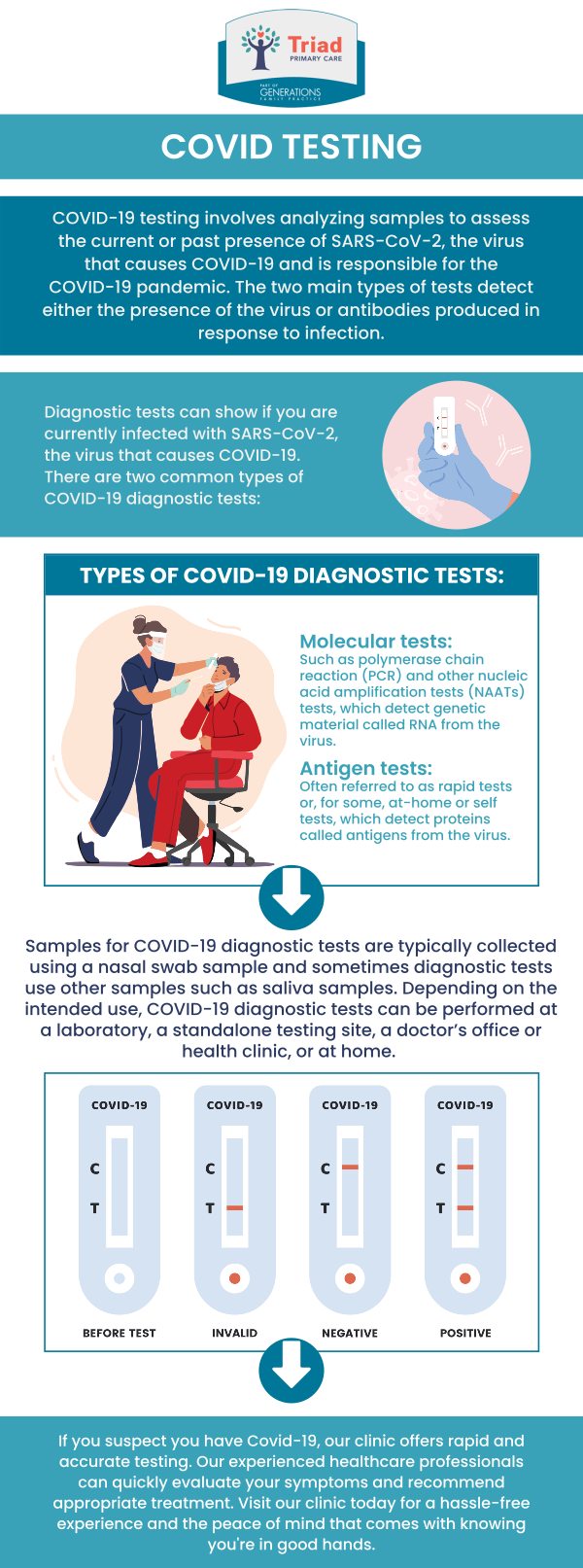
Table of Contents:
Does a COVID-19 test hurt?
How accurate are COVID-19 tests?
What does a negative rapid COVID-19 test actually mean?
Why can I test negative for COVID-19 one day and positive later?
Does a positive COVID-19 test always need to be confirmed with a PCR test?
What if I had COVID-19 within the last 90 days and develop symptoms again?
Can a COVID-19 test tell whether I have the flu or RSV instead?
Can COVID-19 testing help determine whether treatment is needed?
Why is timely COVID-19 testing especially important for people at higher risk?
Does COVID-19 vaccination affect the result of a COVID-19 diagnostic test?
What has changed about COVID-19 guidance that patients should know?
When can I return to normal activities after having respiratory symptoms?
Should I test before visiting an older or immunocompromised person?
How should I prepare for a COVID-19 test appointment?
What happens after I receive my COVID-19 test result?
Request COVID-19 Testing in Greensboro, NC
Medical References
Most nasal COVID-19 tests cause brief discomfort rather than significant pain. Patients may notice pressure, tickling, mild burning, watery eyes, or an urge to sneeze while the specimen is being collected. These sensations usually last only during the swabbing process. The experience can vary based on the collection method, the test being used, nasal congestion, individual sensitivity, previous nasal procedures, and other factors. Patients who have significant nasal problems or have recently undergone nasal surgery should let the healthcare professional know before sample collection. A good specimen is important, so the swab must contact the appropriate area of the nose according to the manufacturer’s instructions. At the same time, unnecessary force should not be used.
Children may feel anxious about nasal testing even when the physical discomfort is minor. Explaining that the swab will be brief and encouraging the child to remain still can make collection easier. Patients who experience unusual or persistent nasal pain, significant bleeding, or another unexpected problem after sample collection should discuss it with a healthcare professional.
No COVID-19 test is 100% accurate. Reliability depends on the type of test, timing, sample quality, symptoms, and how much virus is present when testing occurs. PCR and other NAAT tests are generally more sensitive than antigen tests. CDC considers NAATs, including PCR, the gold standard for detecting a current COVID-19 infection. Rapid antigen testing can still be highly useful, particularly because results are available quickly. The main limitation is that antigen testing is more likely to produce a false-negative result than a molecular test, especially early in infection or when someone does not have symptoms. This is why a single negative rapid test should not automatically be interpreted as proof that a person doesn’t have COVID-19.
FDA-authorized at-home antigen tests use serial testing to improve reliability. People with symptoms should generally perform at least two antigen tests 48 hours apart when the first is negative. People without symptoms generally need at least three tests, each separated by 48 hours. When test results and symptoms do not seem to agree, additional medical evaluation or molecular testing may be appropriate.
A negative antigen result means the test did not detect enough SARS-CoV-2 antigen in that particular sample to produce a positive result. It does not necessarily prove that a person is infection-free. Someone may test negative because they truly do not have COVID-19. However, a negative result can also occur when testing happens very early in an infection, when the amount of virus present is below the test’s detection threshold, or when specimen collection is inadequate.
For this reason, current FDA recommendations emphasize serial testing after a negative antigen result. If symptoms are present, repeat antigen testing should generally occur 48 hours later, for at least two total tests. If there are no symptoms, FDA guidance calls for repeat testing 48 hours after the first negative result and again 48 hours later, for at least three total tests.
Patients who continue to have symptoms despite repeated negative antigen tests may need medical evaluation because COVID-19 is not the only respiratory illness that can cause fever, cough, congestion, sore throat, or fatigue.
This commonly happens because the amount of virus in the respiratory tract changes during an infection. During the first part of an infection, SARS-CoV-2 may be present at levels too low for an antigen test to detect. As the virus multiplies, the amount of antigen in the nose can increase enough for a later test to become positive.
FDA specifically notes that antigen tests are less likely to detect COVID-19 than molecular tests early in an infection or in people without symptoms. This is one reason repeat testing has become an important part of interpreting negative rapid-test results. Timing also explains why testing immediately after an exposure may not provide a useful answer. Infection may have occurred even though detectable viral material has not yet accumulated.
A changing result does not necessarily mean that the first test malfunctioned. It may simply reflect how the infection developed between samples. Patients with continuing respiratory symptoms should continue taking reasonable precautions and follow current repeat-testing recommendations rather than relying on one early negative antigen result.
Not necessarily. CDC states that positive antigen results are generally accurate and reliable. In many circumstances, an additional PCR test is therefore not required simply to prove that a positive rapid antigen result is correct.
There are situations, however, where additional testing may be useful. A healthcare professional may consider the patient’s symptoms, previous infection history, reason for testing, medical risk factors, and whether the test result could substantially affect medical decisions. Molecular testing may also be valuable when a person has significant symptoms but repeatedly receives negative antigen results.
A positive test should also be interpreted in the context of recent COVID-19 infection. Highly sensitive molecular tests can sometimes continue detecting viral genetic material after the period of acute illness, which is why CDC provides different testing considerations for people who have recently had COVID-19. Patients should avoid repeatedly ordering different tests without considering what the result will change. A clinician can help determine whether another test is medically useful or whether the more important next step is symptom monitoring, precautions, or assessment for treatment eligibility.
Testing after a recent COVID-19infection requires more careful interpretation. CDC’s testing guidance distinguishes between people who have and have not received a positive COVID-19 result during the previous 90 days. For someone whose first positive test occurred within the past 30 days and who develops new symptoms, CDC recommends using an antigen test rather than automatically relying on a NAAT/PCR. Negative antigen tests should be repeated according to FDA guidance.
The reason is that molecular tests are highly sensitive and can sometimes remain positive after the initial infection. A new positive molecular result therefore does not always make it easy to distinguish a new infection from lingering viral genetic material from the prior illness. New respiratory symptoms also aren’t automatically COVID-19. Influenza, RSV, and many other infections can cause similar symptoms.
Patients who recently had COVID-19 and become sick again should discuss the timing of their previous infection, their new symptoms, and any risk factors for severe disease with a healthcare professional so the testing strategy can be selected appropriately.
A test designed only for SARS-CoV-2 cannot tell whether symptoms are caused by influenza, respiratory syncytial virus (RSV), or another respiratory infection. COVID-19, flu, RSV, and other respiratory illnesses frequently produce overlapping symptoms. Fever, chills, fatigue, cough, runny nose, headache, sore throat, body aches, and other symptoms can occur with more than one infection.
Some diagnostic products are specifically designed to test for multiple respiratory viruses using one specimen, but not every COVID-19 test has this capability. FDA advises patients to check exactly which viruses a particular test is authorized to detect. Therefore, a negative COVID-19 result should not be interpreted as meaning that a respiratory illness is insignificant.
Patients with persistent or worsening symptoms may need broader evaluation, particularly when they are older, immunocompromised, pregnant, have chronic health conditions, or are otherwise at increased risk for complications. Testing is one part of the evaluation. Symptoms, medical history, examination findings, and—in selected situations—additional laboratory testing can help a healthcare professional determine what may be causing the illness.
Testing can be particularly useful when someone has factors that increase the risk of developing severe COVID-19. CDC’s outpatient guidance advises clinicians to consider treatment for patients with mild or moderate COVID-19 who have one or more risk factors for progression to severe disease. Treatment must be started promptly—generally within five to seven days after symptoms begin, depending on the medication.
Risk increases with age and can also be affected by certain medical conditions, immunocompromising conditions, vaccination status, and other clinical factors. Because the treatment window is relatively short, patients who may be at higher risk should not wait until symptoms become severe before contacting a healthcare professional.
Testing can provide useful diagnostic information, but the result alone does not establish whether a particular medication is appropriate. Antiviral treatments have eligibility requirements, precautions, possible medication interactions, and other considerations.
For a healthy person with mild illness, testing may primarily help clarify the cause of symptoms and guide decisions about preventing transmission. For a person at higher risk of severe COVID-19, testing can have an additional purpose: helping support prompt evaluation for antiviral treatment.
CDC identifies older age as an important risk factor, with risk rising substantially in adults older than 65. Certain underlying medical conditions, multiple medical conditions, immunocompromising conditions, and not being up to date with recommended vaccination can also increase the risk of severe disease.
COVID-19 treatments work best when started early. Depending on the medication, treatment generally must begin within five to seven days after symptoms begin. Someone at higher risk who develops possible COVID-19 symptoms therefore should not spend several days repeatedly testing at home without considering medical evaluation.
This is one reason access to COVID-19 testing through a primary care setting can be helpful: the test can be considered alongside medical history, current medications, symptoms, and risk factors rather than being viewed as an isolated result.
COVID-19 vaccination does not cause a viral antigen or PCR/NAAT diagnostic test to become positive. Diagnostic tests look for evidence of the virus itself—either viral proteins with antigen testing or viral genetic material with NAAT/PCR testing. Vaccines do not produce an active SARS-CoV-2 infection. A vaccinated person can still develop COVID-19, however, so testing may still be appropriate when compatible symptoms or other reasons for testing are present.
Vaccination history can matter in other aspects of care because clinicians consider multiple factors when assessing the risk of severe illness.
One important change compared with advice commonly given earlier in the pandemic is that CDC’s general community respiratory-virus guidance is now based heavily on how symptoms are improving, rather than using a universal fixed isolation period for every respiratory infection. Current CDC guidance advises people with respiratory-virus symptoms to stay home and away from others while sick. Normal activities can generally resume once symptoms have been improving overall for at least 24 hours and any fever has been gone for at least 24 hours without fever-reducing medicine.
After returning to normal activities, CDC recommends additional precautions for the next five days. Depending on circumstances, these may include better ventilation or cleaner air, good hygiene, physical distancing, a well-fitting mask, or testing before being around other people. Another important point is that repeat antigen testing remains essential. A single negative rapid antigen result does not reliably exclude COVID-19. Patients should therefore rely on current guidance rather than old pandemic-era rules that may still appear on outdated webpages or social media posts.
CDC recommends staying home and away from other people while experiencing respiratory-virus symptoms that are not better explained by another cause. A person may generally return to normal activities when, for at least 24 hours, symptoms have been improving overall and fever has been absent without the use of fever-reducing medication.
That does not mean the possibility of spreading infection immediately becomes zero. For the following five days, CDC recommends taking additional precautions because some people may still be capable of transmitting the virus. These precautions can include improving indoor air quality, practicing good hand and respiratory hygiene, maintaining distance when practical, wearing a well-fitting mask, or using testing strategically when planning to be around other people.
Extra care is especially reasonable before spending time with an older adult, someone who is immunocompromised, or another person at higher risk of severe respiratory illness. If fever returns or symptoms begin worsening after normal activities have resumed, CDC advises staying home again until the improvement and fever-free criteria are once more satisfied. Individual circumstances may require different instructions from a healthcare professional.
Testing can be one useful layer of protection before close contact with a person who has a higher risk of becoming seriously ill from COVID-19. The decision is particularly relevant if the person planning the visit has recently had respiratory symptoms, a known exposure, or other reasons to suspect infection.
However, testing has limitations. A negative rapid antigen test represents one point in time and cannot guarantee that a person is not infected or will not become infectious later. This is particularly important after recent exposure because viral levels may still be too low for an antigen test to detect.
If an antigen test is negative but there is meaningful concern about infection, FDA recommends serial testing rather than relying on one test. Other precautions can also help reduce risk, including avoiding visits when actively ill, improving indoor ventilation, using a well-fitting mask when appropriate, and paying attention to current respiratory symptoms. Testing should therefore be viewed as one tool rather than a guarantee of safety. Combining sensible precautions is especially valuable when protecting someone at increased risk for serious complications.
Most COVID-19 testing requires little special preparation, but providing accurate information can help make the visit more useful. Patients should be ready to describe their symptoms, when symptoms began, possible recent exposure, previous COVID-19 infections, and any recent home-test results. Bringing the name or a photo of an at-home test can sometimes be useful when there is uncertainty about what type of test was performed.
Patients at increased risk for severe COVID-19 should also have an up-to-date medication list available. This is particularly important if treatment may need to be considered, because some antiviral medications can interact with prescription medicines and other products. Before arriving at a healthcare facility while experiencing respiratory symptoms, follow the practice’s current instructions regarding check-in, masking, or other infection-control procedures.
There is generally no need to fast for a routine nasal COVID-19 test. However, patients should follow any specific instructions given for the exact diagnostic test being performed. Triad Primary Care currently provides COVID-19 testing.
The next step depends on the result, symptoms, medical risk, and type of test performed. A positive result indicates that SARS-CoV-2 was detected and should prompt precautions to reduce transmission. Patients who are older or have health conditions that increase their likelihood of severe COVID-19 should seek medical guidance promptly because antiviral treatment, when appropriate, needs to begin early.
A negative PCR/NAAT result makes current COVID-19 less likely but should still be considered alongside symptoms and timing. A single negative antigen test is less conclusive. Patients should follow FDA repeat-testing recommendations, particularly when symptoms or recent exposure make COVID-19 possible.
Persistent symptoms may also have another cause, including influenza, RSV, or another respiratory condition. Continued or worsening illness therefore deserves attention even when COVID-19 testing remains negative. Anyone experiencing severe symptoms such as difficulty breathing, persistent chest pain or pressure, new confusion, inability to stay awake, or other emergency warning signs should seek emergency medical care rather than waiting for another routine test. Triad Primary Care provides COVID-19 testing alongside primary care and laboratory services for patients in Greensboro and surrounding communities.
Frequently Asked Questions
How quickly will I receive my COVID-19 test results?
Rapid antigen tests commonly provide results within approximately 15–30 minutes. PCR/NAAT turnaround can vary depending on the testing method and laboratory processing. Patients should confirm the expected turnaround time when scheduling or receiving their test.
Do I need an appointment for a COVID-19 test at Triad Primary Care?
Appointment procedures can change. Patients should contact Triad Primary Care or use the practice’s online appointment option to confirm current COVID-19 testing availability before visiting.
Does insurance cover COVID-19 testing?
Coverage depends on the patient’s insurance plan, the reason for testing, and current benefits. Patients should verify testing coverage and possible out-of-pocket costs with their insurance carrier and the practice before testing.
When should COVID-19 symptoms be treated as an emergency?
Seek immediate medical care for symptoms such as difficulty breathing, persistent chest pain or pressure, new confusion, inability to wake or remain awake, or other severe or rapidly worsening symptoms.
COVID-19 testing can help patients understand the cause of their symptoms, make informed decisions about protecting others, and identify situations where prompt medical care may be appropriate.
Triad Primary Care offers COVID-19 testing at 1309 Lees Chapel Rd., Greensboro, NC 27455. Patients can contact us or book an appointment online to confirm testing availability and determine the appropriate next step.
Check Out Our 5 Star Reviews



Additional Services You May Need
▸ Covid-19 Testing
▸ Medical Weight Loss
▸ Physical Exams
▸ Addiction Treatment
▸ Primary Care
▸ Lab Testing



 Send Text
 How May I Help You?
